
Menu

EARTHQUAKE AND BUILDING STRUCTURES
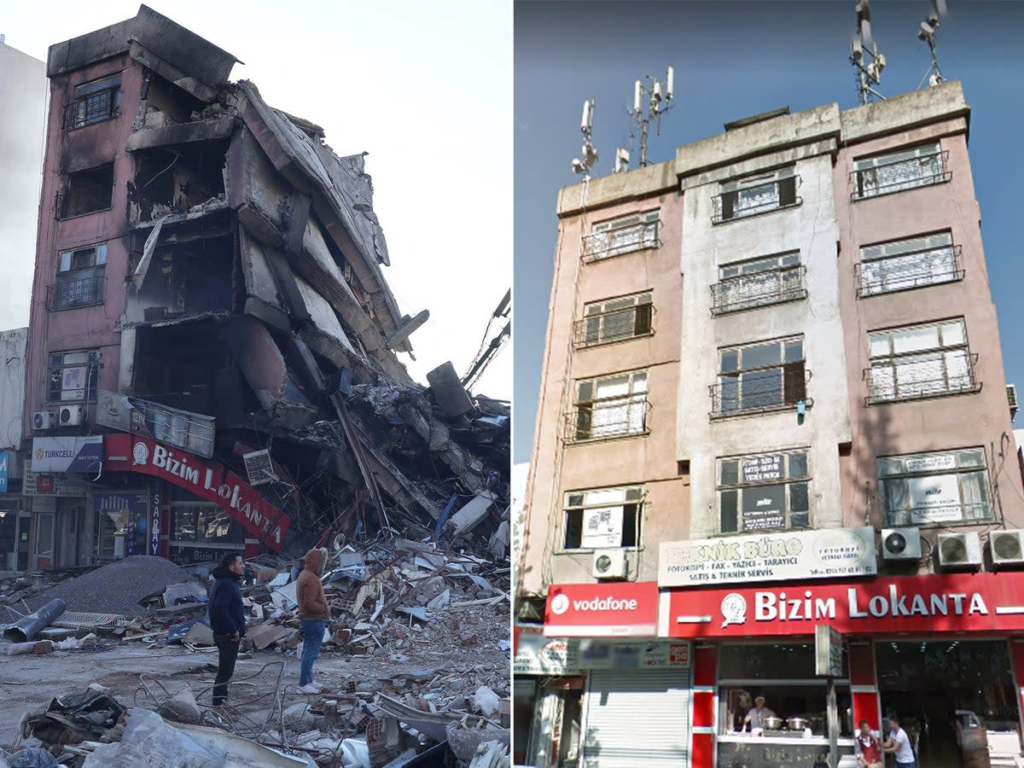
Left: Collapsed buildings in Central Kahramanmaras, near the epicentre of the February 06, 2023 Earthquake. Right: Same street in 2018. (AFP/Getty/Google)
Earthquake is an intense shaking of the ground surface caused by sudden movements along the fault lines. Such movements release energies which are spread through the Earth's layers in the form of seismic waves. The sudden movements usually occur due to long-term deformations and the built-up stresses within the Earth.
The strength of Earthquakes is commonly measured using two scales;
1. Richter scale; measures the Magnitudes by estimating the amount of energy released at the source of the Earthquake
2. Mercalli scale; measures the Intensities based on witnesses personal experiences and the observed extent of damage to buildings at a given area
The Richter scale was developed scientifically using the Mercalli scale and the accurate records of measurements from seismographs by C. F. Richter (an American seismologist). The Richter scale simplified the comparison of magnitudes regardless of the global location.
In February 06, 2023, Turkey and Syria experienced one of the most catastrophic Earthquakes with Magnitudes of 7.8 in 100 years. Apparently, Turkey is located in an area with several fault lines, making it one of the countries with the most active Seismic zones globally.
In Kenya, the Earthquake hazard is classified as medium meaning that there is a 10% chance for the occurrence of potentially damaging Earthquake within the mapped Seismic zones in 50 years. The highest Magnitude ever recorded in Kenya is 6.9 in the year 1928.
The Structural Engineers and other Construction professionals in Kenya must always consider the effects of Earthquake Hazard in all phases of project implementation including project planning decisions, project designs and construction methods.
The Structural Engineers should therefore, design Earthquake Resistant building structures with sufficient strength and ductility to withstand large tremors. Most of the Earthquake design standards provide for buildings that can;
1. Resist minor Earthquakes without damage
2. Resist moderate Earthquakes without significant structural damage, but possible non-structural damage
3. Resist major Earthquakes without collapse, but possible structural and non-structural damage
The Ground movements due to Earthquakes usually cause the various parts of buildings to move differently with respect to their foundation, which results into relative deformation and generation of additional internal forces within the buildings structure
It is worth noting that, to manage potential damage to buildings during major Earthquakes, the following global design approaches have been recommended; increase ductile behavior of the building frame to allow for inelastic responses, increase damping using the energy dissipation devices, and/or increase natural period by isolating the building foundations.
Published by Geostruct (May 08, 2023)

Phone No.: +254 739 968175
P. O. Box 1334 - 00100, Nairobi, Kenya
Click here to send us an email